
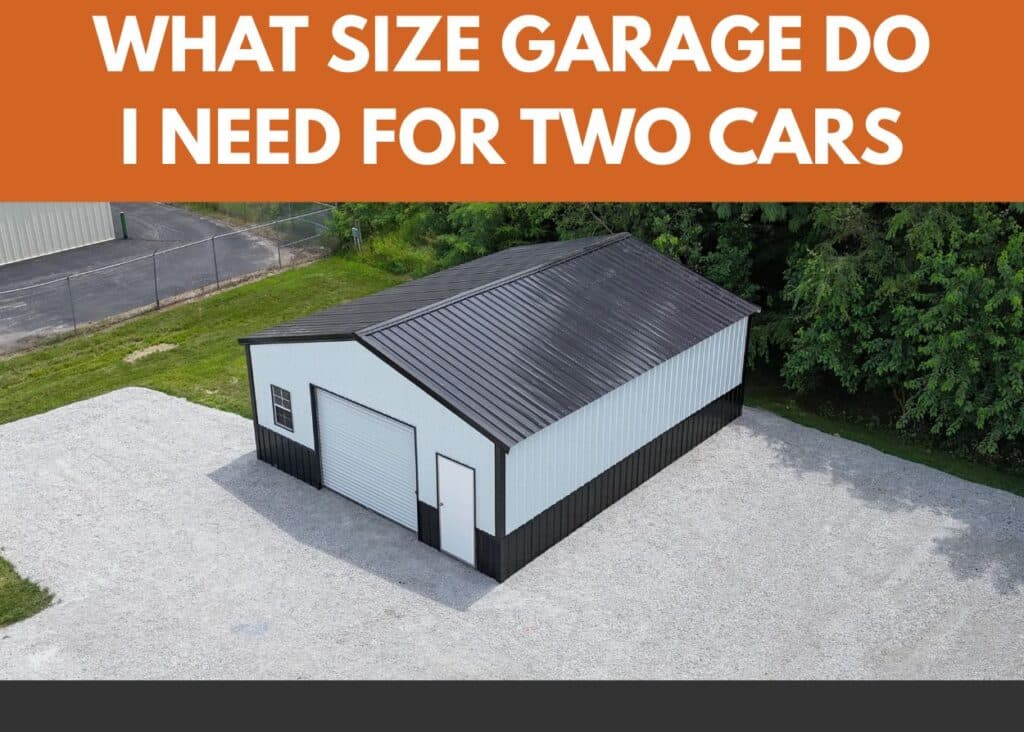
What Size Garage Do I Need For Two Cars? A practical homeowner’s guide
You’re planning your dream garage. Maybe you’re tired of your vehicles being exposed to the elements. Or maybe your single-car garage just isn’t cutting it anymore. Whatever the reason, you’re wondering:
What size garage do I need for two cars?
Short answer: It depends.
Long answer? Keep reading—at Creative Backyards, we sell more than just sheds and gazebos—we also offer metal garages. We’re thrilled to partner with Northwest Missouri Carports to bring you the best in metal and steel structures. We’ll walk you through the ideal dimensions, what to consider based on your vehicle size, how to plan for storage or hobbies, and helpful tips.
Table of Contents
- Sizing Your Garage Right From The Start
- Two-Car Garage Dimensions: What Most Homeowners Choose
- Vehicle Types Change Everything
- How Much Extra Space Do You Need?
- Garage Door Sizes for Two-Car Garages
- Ceiling Height and Overhead Storage
- Common Mistakes to Avoid When Sizing Your Garage
- Rural vs Suburban: How Location Affects Size
- Attached vs Detached Garages
- What About Prefab Garages?
- Don’t Forget About Zoning & Permits!
- Summary: What Size Garage Do I Need?
- Conclusion
Don’t Have Time to Read the Whole Blog? Here are the main points:
- A standard 24′ × 24′ garage is the most popular for two cars — gives decent space for vehicles plus a little storage.
- If you drive larger vehicles (SUVs, trucks) or want extra workspace, lean toward larger dimensions like 24′ × 28′, 26′ × 30′, or even deeper.
- Allow extra clearance in front, behind, and between cars: add ~3 feet front/back per vehicle, +2‑3 feet on each side for walkways.
- Ceilings of 9‑10 feet are recommended to support overhead storage, lifts, or future needs—better to build up than try to retrofit.
- Don’t forget to check local zoning, permits, setbacks, HOA rules, and whether the garage will be attached vs detached—they all impact what you can build.
Read on to find out more detailed information!
Article Summary:
Determining the ideal two-car garage size depends on vehicle types, storage needs, and potential future uses. While 24′ x 24′ is a popular standard, larger dimensions like 24′ x 28′ or 26′ x 30′ offer ample room for vehicles, storage, and workbench space. Planning for extra depth, higher ceilings for overhead storage, and considering zoning laws are crucial for a more functional and future-proof garage.
Sizing Your Garage Right From the Start
Let’s face it—nobody ever says, “I wish I had a smaller garage.”
Whether you’re building a new home, adding to an existing one, or installing a prefab garage, size is one of the most important decisions you’ll make.
Here’s why:
- Your cars need protection. Snow, hail, and UV rays can quickly wear down vehicles.
- You need more storage. Bikes, yard tools, and seasonal decorations add up quickly.
- Your home’s value increases. A functional two-car garage is a strong resale feature.
- You want room to move. Cramped garages cause frustration—and door dings.
So let’s break it down and help you make the right call.
Two-Car Garage Dimensions: What Most Homeowners Choose
If you Google it, you’ll see a range of “standard” two-car garage sizes. But here’s a helpful breakdown:
| Garage Size | Description |
| 20′ x 20′ | The bare minimum. Fits two small cars tightly. Little room to walk. |
| 22′ x 22′ | Slightly better. Can squeeze in compact or mid-size vehicles. |
| 24′ x 24′ | Most popular. Comfortable fit for two vehicles with some storage. |
| 24′ x 28′ or 26′ x 30′ | Ideal. Ample room for vehicles, storage, and workbench space. |
Think of it like a pair of jeans.
Sure, you can squeeze into the smalls. But why not go for comfort—and pockets?
Vehicle Type Changes Everything
A garage that fits a compact car, such as a Toyota Corolla or a Honda Civic, might not work for a truck or large SUV like a Ford F-250 or a Chevy Suburban.
Let’s look at average vehicle lengths:
- Compact Cars: 14–15 feet
- Mid-size SUVs: 16–17 feet
- Full-size Trucks or SUVs: 19–21 feet
Now add at least 3 feet of clearance in front and at the back. If your garage is only 20 feet deep, and your truck is 20 feet long, guess what? You’re parking diagonally… or outside.
So if you drive:
- Two sedans? A 20′ x 20′ garage is workable but tight.
- A truck and an SUV? You’ll want 24 feet deep, at a minimum.
- Two large trucks? Go 28–30 feet deep.
If you have anything that extends the length of your vehicle, like a hitch-mounted rack for a bicycle, cargo carrier, or mobility scooter, it will require additional consideration for space. Add at least an extra 3 feet of space in addition to clearance space.
And that’s before adding any storage space.
How Much Extra Space Do You Need?
Most people use their garage for more than just parking.
Think about everything else that ends up in there:
- Bikes and scooters
- Lawnmowers or snowblowers
- Rakes, shovels, and hoses
- Storage totes and holiday decorations
- Recycling bins or trash cans
- Extra fridge or freezer
If you want a garage that functions—not just one that holds cars—you’ll need to plan for extra space for those add-ons. Here’s how much to add.
Feature Add to Dimensions
Walkway on sides +2 to 3 feet on each side
+2 to 3 feet on each side +2 to 3 feet on each side
Workbench or hobby zone +4 to 6 feet of depth
Overhead storage loft Consider 9–10 ft ceiling height
So a garage that’s 24′ x 28′ gives you breathing room—and elbow room.
Garage Door Sizes for Two-Car Garages
Your garage size is one thing—but your garage door also plays a huge role in usability.
Here are your main options:
One Double Door
- 16 feet wide x 7 feet tall (standard)
- Ideal for simultaneous entry/exit
- Simpler and cheaper to install
Two Single Doors
- 8–9 feet wide each
- More symmetrical look
- Safer for opening one door at a time
Pro tip: If you drive trucks or SUVs with roof racks or snowplows, opt for 8-foot-tall doors to avoid clearance issues.
Ceiling Height and Overhead Storage
We’ve talked about width and depth. Now let’s talk about height.
A typical garage ceiling is 8 feet high. But consider going 9 or 10 feet for added flexibility.
Why?
- It lets you add overhead storage for seasonal items.
- You can install garage ceiling lifts for bikes, kayaks, or even a Jeep hardtop.
- If you ever want to install a car lift, you’ll need the headroom.
Bottom line: Height is cheap to add during the build. It’s much more complicated and expensive to do it later.
Common Mistakes to Avoid When Sizing Your Garage
Investing in structure requires planning and forethought, and unfortunately, some people make the mistake of discovering what got left out after the structure is built. Here are some of the biggest mistakes homeowners make when sizing a garage:
1. Underestimating Storage Needs
Cars take up space. But so do the things you use because you have cars—like snow tires, jacks, or roof racks.
2. Ignoring Walkway Clearance
At least 30 inches between the side of your car and the wall is ideal. Anything less and you’re squeezing through sideways.
3. Forgetting the Workshop
You may not be a full-time mechanic. But even basic maintenance—like oil changes or tire rotations—requires space to move.
4. Not Planning for the Future
Maybe you drive small sedans now. But what happens when you upgrade to an SUV or minivan?
5. Laying out a floor
Don’t forget the floor. A concrete pad is the recommended base for a garage, especially if you’re looking at using the garage as a multi-function building.
Rural vs. Suburban: How Location Affects Size
Where you live plays a significant role in determining your garage size.
In the Suburbs:
Living in the suburbs may offer the convenience of city life, including access to nearby stores and amenities. It also offers greater opportunities for socializing, since you can walk over and knock on your neighbors’ doors. There are a few drawbacks, however, when it comes to adding a garage structure:
- Lot sizes are smaller than in rural areas
- Local codes or HOAs might limit square footage
- You’ll need to fit your garage within the existing driveway dimensions
In Rural Areas:
The sky’s the limit in rural areas. It’s common to see garage structures in rural communities, since they are built larger to accommodate vehicles and storage. While that doesn’t mean you have to build it bigger, you have more flexibility to build what you want:
- You likely have more land to work with
- You might want extra garage bays for equipment or trailers
- A 30′ deep garage with three doors is more common
And if you’re using your garage for homesteading gear, wood storage, or ATVs—build even bigger.
Attached vs. Detached Garages
The type of garage you choose affects your sizing, too.
Attached Garage
- Easier access to the house
- Can share utilities (like HVAC or electricity)
- Typically built during home construction
Detached Garage
- More design freedom
- Can double as a workshop, man cave, or guest house
- Less noise is transferred to your home
- How about utilities? A detached garage is a prime candidate for solar power.
Detached garages often have more flexibility in size and layout—making them an excellent choice for multi-use spaces.
What About Prefab Garages?
Prefab or modular garages (like the ones we offer at Creative Backyards) are built off-site, delivered to your property, and installed quickly.
Benefits include:
- Fast installation
- Less construction mess
- Customizable layouts and features
- Lower cost compared to complete custom builds
And yes—you can still get a 24′ x 28′ garage with a loft and storage upgrades.
Don’t Forget About Zoning & Permits!
One last thing—check with your city or county about zoning and permits.
Some common rules to look for:
- Setback requirements (distance from property lines)
- Maximum structure height
- Lot coverage limits
- Permit requirements for electrical, plumbing, or HVAC
At Creative Backyards, we help you navigate all of this before you build.
Summary: What Size Garage Do I Need for Two Vehicles?
Here’s your quick cheat sheet:
Use Case Recommended Size
Parking for two small cars 20’ x 20’ (but it’s a tight fit)
Two midsize vehicles 22’ x 22’ (recommended 24’ x 24’)
With storage or workshop 24’ x 28’ (recommended 26’ x 30’)
With trucks, SUVs, or trailers 26’ x 32’ and above
Extra-tall ceiling for storage/life 9’ – 10’ recommended height
Conclusion
Don’t settle for a one-size-fits-all garage. Creative Backyards has you (and your cars) covered! We specialize in prefab garages designed to meet the needs of everyday homeowners across Eastern & Central Nebraska, Western Iowa, Northwest Missouri, and Northeast Kansas.
We offer durable, made-in-the-USA materials, friendly, professional service, custom sizing to match your vehicles, lifestyle, and property, and options for insulation, windows, doors, and lofts.
Contact us now to get started on your two-car garage!
Other Posts

Grain Bin Gazebos: An Attractive And Cost-effective Outdoor Addition
Prefab Cabins: Your Ultimate Backyard Transformation Guide – Pros, Cons, and Beyond